Nabhi Vastu  ·  The Center-First Reading  ·  Bombay

Mr. Nilesh Shah

Every home has a navel.

The center decides what the corners can do. Nabhi Vastu reads a house from the brahmasthan outward, because a correction at the edge cannot hold if the middle is wrong.

01 / The Practitioner

Everyone measures the walls. Almost nobody reads the middle of the room.

Mr. Nilesh Shah reads houses the slow way. Born in Mansa, Gujarat, and shaped by the old courtyard homes of the region, he grew up in architecture that understood something modern floor plans forgot: the middle of a house is not spare space. It's the lung. The old builders left it open, kept it light, and built the rooms around it.

His practice, Nabhi Vastu, begins where those builders began. In the Vastu Purusha Mandala, the center of the dwelling is the purusha's nabhi, his navel, the point the whole body of the house is fed from. Read that point first, honestly, and the rest of the house explains itself. Skip it, and you end up rearranging furniture for years.

He is not a dramatic consultant. There's no fear in the reading, no catalogue of doom, and no pressure to demolish anything. Most of what he prescribes is subtraction: weight lifted off the center, a blocked skylight opened, a stored cupboard moved off the heart of the home. Quiet corrections, made once, that keep working.

He works alongside his wife, Mrs. Shilpa Shah, whose own practice reads the eight directions. Between the two of them, a house gets read the way it deserves: from its edges, and from its center.
0+Years with the old homes
0+Centers read
0States of practice
1Center. Everything begins there.

The old houses kept their middle empty. That was not a waste of space. That was the design.

A courtyard doing its work · Gujarat

02 / The Practice

Five ways in, one center.

01

The Nabhi Reading

The full center-first reading of a home or workplace. The brahmasthan is located precisely, not guessed, then read for the four burdens: weight, water, walls and clutter. Only after the center is understood do the rooms around it get their turn. Residential and commercial.

  • Precise location of the brahmasthan
  • The four burdens checked at the center
  • Room-by-room reading, center outward
  • A written correction plan, in plain words
02

Brahmasthan Correction

When the center is already carrying what it shouldn't, a staircase, a store room, a toilet, a pillar, this is the discipline of undoing it without breaking the house. Most corrections are subtractions and placements, not demolition. The heavy option is the last option, always.

  • Non-destructive corrections first
  • Weight, water and storage relocation
  • Light and air restored to the center
  • One follow-up visit after the changes
03

Plot & Site Selection

The cheapest correction is the one you never need. Before land is bought or a flat is booked, the site is read for its slope, its shape, what sits at its center and what the center will become once walls go up. An hour here saves years later.

  • Plot shape and slope reading
  • The future center, mapped before walls exist
  • Flat and floor selection guidance
  • A clear yes, no, or yes-with-conditions
04

New Home & Griha Pravesh

Moving in is the one moment when everything is still movable. The reading happens before the boxes are opened: what belongs where, what must never sit on the center, and how the first days in a house set its long habit. The griha pravesh is aligned to the home, not just the calendar.

  • Pre-move placement plan for every room
  • The center kept open from day one
  • Griha pravesh guidance
  • A settling-in review after the first month
05

Ongoing Guidance

Houses change. Families grow, rooms swap purposes, a cupboard drifts onto the center without anyone deciding it. For households that want a standing relationship, he stays available: a call before any big change, a walk-through once a year, the center checked the way one checks anything that matters.

  • A call before renovations and rearrangements
  • An annual walk-through of the home
  • Guidance as the family's needs change
  • Priority visits when something feels off

03 / The Nabhi Grid

The Nabhi

Brahma, at the navel of the house

KeeperBrahma
ElementSpace
GovernsEverything around it

The brahmasthan is the one part of a house that serves by staying empty. No weight, no water, no walls, no clutter. Give it light and air and it feeds every room around it. Load it, and the whole house works harder than it should.

Tap any zone  /  the center is where he starts

A house is read standing in its middle, looking outward. Not the other way around.

Three doors, one axis

04 / The Method

Five checks of the center.

N / 01

What sits on it.

Weight is the first burden. Staircases, heavy cupboards, pillars, store rooms. The center carries the house; it shouldn't carry the luggage too.

N / 02

What flows under it.

Water at the brahmasthan, a tank, a drain, a bathroom above it on the next floor, unsettles the stillest point of the home. It gets found, then moved or managed.

N / 03

What cuts it.

Walls that slice through the center chop the house into competing halves. Sometimes a doorway is enough to reconnect them. Sometimes the reading simply works around what can't move.

N / 04

What light reaches it.

The old courtyards put the sky right above the middle. A modern flat can't, but it can stop blocking what light there is. The center should be the brightest honest point of the home.

N / 05

What the family does in it.

The last check is the living one. If the middle of the home is where everyone naturally gathers, the house is already half right. If everyone avoids it, that avoidance is data.

05 / In Their Words

He spent the first hour in the middle of our hall, saying almost nothing. Then he moved three things, none of them expensive, and the house started feeling like it was breathing again.
M. Parekh
Residential reading, Mumbai
Every consultant we'd met wanted to break something. He wanted to empty something. Our office center was a store room; it's a meeting table now, and the difference is hard to explain and easy to feel.
R. Doshi
Workplace reading, Ahmedabad
We took him to see a plot we'd nearly paid for. He stood at what would have been its center and said, gently, keep looking. The one he approved two months later is the house we live in today.
S. Trivedi
Site selection, Gujarat
01 / 03

06 / Correspondence

Start from the center.

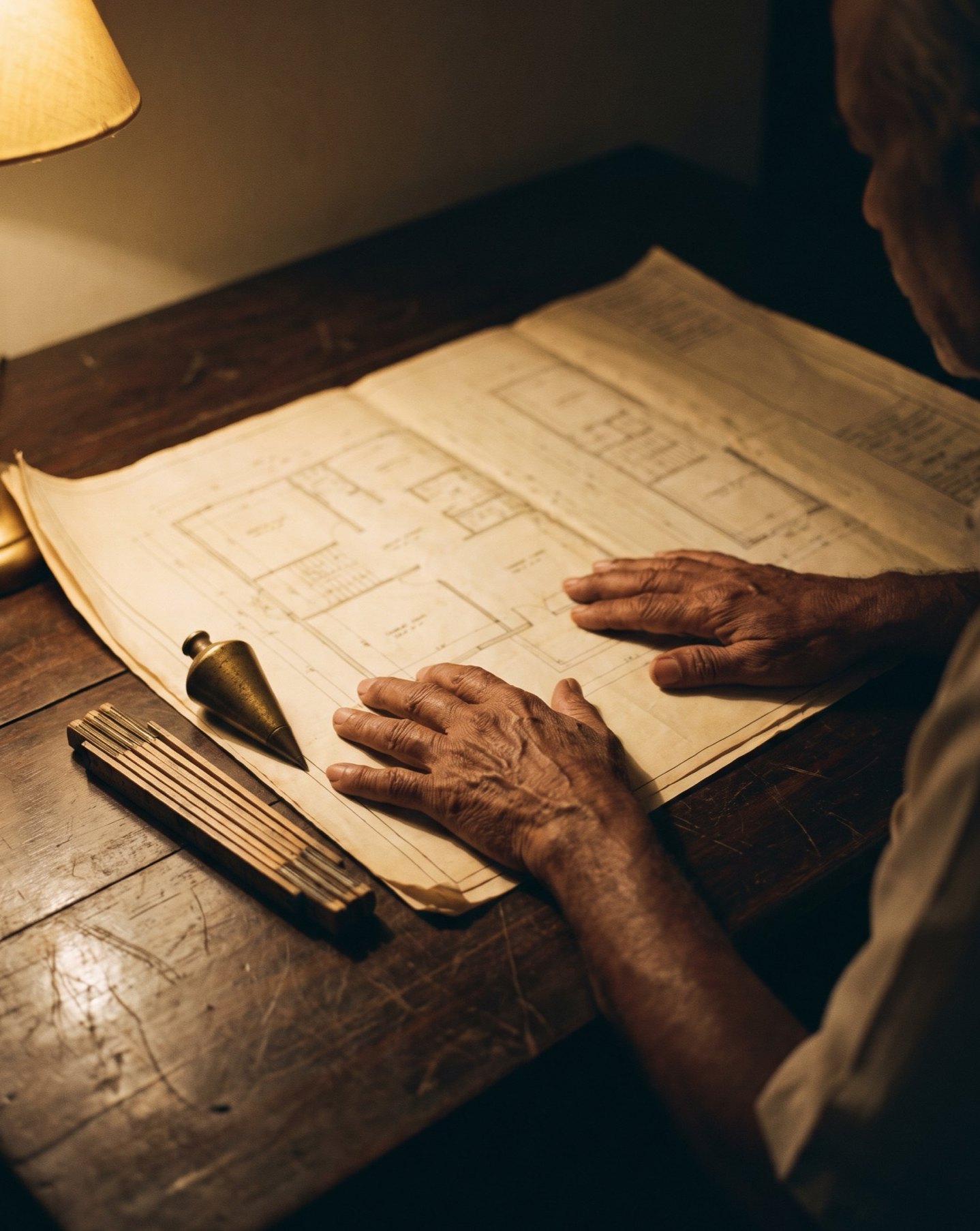
Hands resting on an old floor plan
The reading begins on paper